SPUR (2025) 9 (1): https://doi.org/10.18833/spur/9/1/4 Abstract:
Responsible conduct of research (RCR) is a crucial aspect of research ethics that applies to everyone involved in research. While RCR training is often emphasized for graduate students and postdoctoral researchers, many institutions and funding agencies require undergraduates to complete it, particularly if they are supported by federal grants. RCR training for undergraduate students can sometimes be overlooked, as their involvement in research is not as prominent or numerous as that of graduate students or postdoctoral researchers.
SPUR (2025) 9 (1): https://doi.org/10.18833/spur/9/1/1 Abstract:
Many undergraduate research (UR) programs require students to be trained according to responsible conduct of research guidelines, which concentrate on the technical aspects of performing research. In this commentary, we explain that undergraduate projects may require special ethical considerations when social, cultural, and legal circumstances are an integral feature of the research. The authors’ opportunity to work with human remains prompted the realization that undergraduates in any discipline may need additional ethical training to help prepare them to cope with the subject matter specific to their research project. We advocate for mentors to become aware of the potential emotions and concerns their UR students might encounter conducting this research and to prepare them to address and handle these unique ethical challenges.
SPUR (2025) 9 (1): https://doi.org/10.18833/spur/9/1/8 Abstract:
Educational researchers use a variety of data collection tools with the goal of measuring students’ educational experiences, learning, and outcomes. Measurement validity is essential for ensuring that research findings lead to trustworthy conclusions. Yet it can be challenging to understand what measurement validity is, how it is established, and why it matters when drawing conclusions from educational data. In this commentary, we introduce educational measurement with a focus on validity. We explain the process of assessing the validity of an educational measurement tool and how conclusions can be undermined when we ignore validity. We offer recommendations for identifying measurement tools with strong validity evidence and point readers to resources that have informed our understanding and application of measurement validity in our own educational research.
More Articles in this Issue
 Introduction‐ Lorraine Wallace
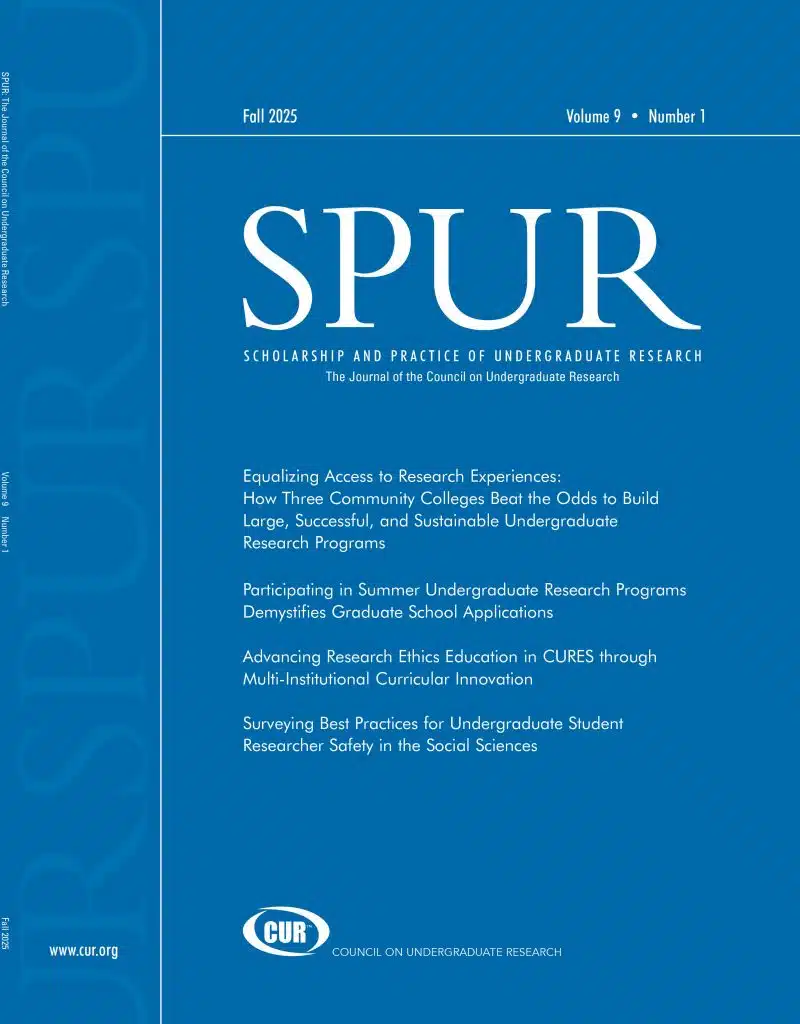
SPUR (2025) 9 (1): https://doi.org/10.18833/spur/9/1/9 Abstract:This issue explores a broad array of timely and thought-provoking topics centered on the responsible and ethical conduct of undergraduate research. Featured articles address subjects such as copyright, responsible conduct of research training, ethical challenges in working with human remains, and the importance of measurement validity in educational research. Additional contributions examine strategies for developing and sustaining undergraduate research programs at community colleges, transition of undergraduate researchers to graduate study, advancement of research ethics education within course-based undergraduate research experiences, and best practices for ensuring researcher safety in the social sciences. Together, these articles provide valuable insights and practical guidance for the undergraduate research community, encouraging readers to reflect on and strengthen ethical practices within their own programs and disciplines.
- Editorial‐ Patricia Ann Mabrouk
SPUR (2025) 9 (1): https://doi.org/10.18833/spur/9/1/3 Abstract:Because this issue highlights the responsible and ethical conduct of undergraduate research, I want to discuss a topic that is often overlooked and not well understood: copyright. Copyright is an essential form of intellectual property that protects the legal rights of creators of copyrightable works and governs those who use these works. Therefore, I will briefly outline the key aspects of copyright that prospective SPUR authors should consider before submitting their research for publication in SPUR or other journals. SPUR readers should be aware of these aspects before reusing any published works without permission.
 Article‐ Daniel Beugnet
SPUR (2025) 9 (1): https://doi.org/10.18833/spur/9/1/6 Abstract:A raft of research has affirmed the efficacy of undergraduate research (UR) as a best practice for improving student outcomes at community colleges. Yet in spite of these impressive outcomes, UR remains rare at community colleges. A small number of institutions, however, have implemented UR successfully, although few studies have examined how and why these programs have become so successful. This qualitative multiple case study explored the implementation processes of successful UR programs at three geographically diverse community colleges. Findings indicated that these three institutions sustained their UR programs through faculty-led administration, support from system-level administrators, and cost-containment strategies specific to the community college context.
- Article‐ Callie L. Avondet, Yolanda Chavez, Timothy W. Collins, Sergio Armendariz, Sara E. Grineski, Danielle X. Morales
SPUR (2025) 9 (1): https://doi.org/10.18833/spur/9/1/7 Abstract:While quantitative research has revealed that undergraduate research experiences are closing graduate school matriculation gaps for underrepresented students, little is known about how they are doing this. This study explores this through two in-depth interviews with 12 students who attended a National Science Foundation Research Experiences for Undergraduates (REU) Site in summer 2022 and were enrolled in graduate school as of fall 2023. Ten reported an underrepresented identity. Via mostly informal interactions with faculty and graduate student mentors and program directors, students learned whether graduate school was for them, how to apply, how to identify schools, and more about their own research interests. Findings demonstrate that REU Sites, specifically through informal interactions, play an important role in transmitting the hidden curriculum to undergraduate students interested in postgraduate education.
- Article‐ Aimee A. Hernandez-Gaytan, Ricardo Ruiseco, Pedro Mendoza, Jeffrey T. Olimpo
SPUR (2025) 9 (1): https://doi.org/10.18833/spur/9/1/2 Abstract:Responsible and ethical conduct of research (RECR) education is essential for the preparation of future scientists but is often overlooked for undergraduate scholars. To address this concern, the Ethics Network for Course-based Opportunities in Undergraduate Research (ENCOUR) engaged facilitators of course-based undergraduate research experiences (CUREs) in the development of RECR-focused student learning objectives (SLOs) for their courses. In this qualitative study, 158 facilitator-created SLOs were analyzed, using Bloom’s Taxonomy to classify cognitive level and to capture patterns in how facilitators attended to RECR. Findings revealed that 41 percent of SLOs targeted higher-order skills, whereas 59 percent focused on lower-order skills. SLOs frequently incorporated research and RECR-specific terminology alongside CURE characteristics. These results guide CURE facilitators seeking to design RECR curricula that support ethical reasoning in undergraduate STEM education.
- Article‐ Andrea J. Sell, Angelina Garcia
SPUR (2025) 9 (1): https://doi.org/10.18833/spur/9/1/5 Abstract:Students in the social sciences are increasingly engaged in research on sensitive topics; however, little is known about the protection they receive from risks that can arise from conducting this type of research. For example, students may experience vicarious trauma from analyzing sensitive data or face harassment from people who disagree with their topic. Faculty and administrators were surveyed to examine perceptions of the use, efficacy, and importance of safety practices. Items included policies regarding working alone or at night, as well as mentors discussing counseling resources with students. Overall, it is hoped that the findings raise awareness of potential risks to student researchers and encourage faculty research mentors and institutions to adopt more proactive prevention measures as a key part of ethical research involving undergraduate students.