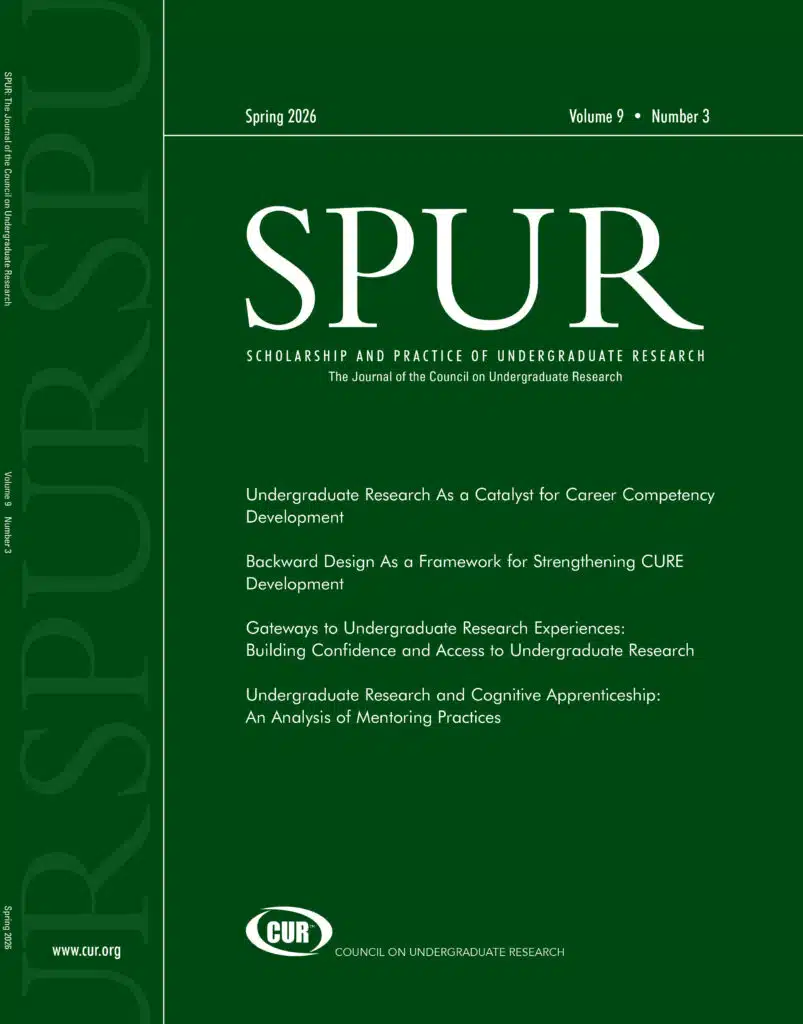
SPUR (2026) 9 (3): https://doi.org/10.18833/spur/9/3/1 Abstract:
The National Association of Colleges and Employers identifies eight career readiness competencies undergraduates should practice before graduation. To emphasize the importance of undergraduate research to developing student awareness and confidence in these competencies, the Office of Undergraduate Research at UNC Charlotte created discrete student learning outcomes to frame student learning through undergraduate research in the career competency areas. Students’ self-assessed confidence and mentors’ descriptions of student behaviors were assessed for growth in these career competencies. This one-year pilot study demonstrates strong association of career readiness with undergraduate research and significant development of career readiness among participants. This study sets the stage to more deeply investigate the structures and mentoring practices that promote career readiness through undergraduate research.
SPUR (2026) 9 (3): https://doi.org/10.18833/spur/9/3/6 Abstract:
Course-based undergraduate research experiences (CUREs) increase student engagement, persistence in STEM, and development of scientific practices. Although recent publications address implementation logistics, few studies specify curriculum development methods that result in inclusion of scientific practices and authentic research while maintaining necessary scaffolding. This article describes a professional development experience using backward design to support such curriculum development. Four analytical co-principal investigators engaged in backward design modules leading to the development of the μCURE project. Evaluation of the μCURE included student perceptions and analysis of teaching materials using modified inquiry and Three-Dimensional Learning Assessment Protocol (3DLAP) rubrics. Results showed high student perceptions of learner-centeredness, nearly authentic levels of inquiry, and increase in the presence of scientific practice prompting. The backward design method was found to strengthen high-quality CURE development.
More Articles in this Issue
 Introduction‐ Niharika Nath
SPUR (2026) 9 (3): https://doi.org/10.18833/spur/9/3/8 Abstract:Undergraduate research continues to evolve as a defining feature of high-impact educational practice, shaping not only how students learn, but also how they prepare for careers, develop confidence, and engage with scholarly communities. Once viewed primarily as an enrichment opportunity for a select group of students, undergraduate research is now increasingly recognized as a central component of undergraduate education. This is evidenced as institutions are expanding access, embedding research into curricula, and aligning experiences with broader educational goals. Yet, as undergraduate research grows in scale and visibility, there is the need to ensure that these experiences remain meaningful, equitable, and sustainable. The Spring 2026 issue of Scholarship and Practice of Undergraduate Research explores this transition, emphasizing that the value of undergraduate research lies not in its availability alone, but in how it is intentionally designed, supported, and experienced by students and faculty.
- Editorial‐ Lorraine S. Wallace
SPUR (2026) 9 (3): https://doi.org/10.18833/spur/9/3/7 Abstract:Over the course of my career as a health science educator, I have had the opportunity to work with undergraduates across a range of global settings, from classrooms in the United States to collaborations with faculty and learners in Southeast Europe and Southeast Asia. These experiences have been consistently energizing, not only because of the enthusiasm students bring. Yet, I have also found myself reflecting on a persistent disconnect. Many of our students engage in global learning through education abroad programs or internationally themed coursework, and many participate in undergraduate research. Too often, however, these experiences remain separate. Global learning is observational; research is local. While students travel, reflect, and return, they rarely contribute to knowledge that is co-created with the communities they engage. If undergraduate research is to meet the demands of an interconnected world, I believe it must evolve. It must move beyond locally restricted, student-centered projects toward reciprocal, globally engaged partnerships that generate value for both learners and collaborators.
 Article‐ Elizabeth Wimberly-Young, Vanessa C. Morales, Kathleen F. Weaver
SPUR (2026) 9 (3): https://doi.org/10.18833/spur/9/3/5 Abstract:Creating equitable access to undergraduate research remains challenging. Students early in their academic careers and those from historically marginalized groups continue to engage in research experiences at disproportionately lower rates. This study hypothesized that self-efficacy in research ability would influence student participation. Loyola Marymount University created the research learning community (RLC), designed to build research skills, enhance student confidence, and serve as a gateway to undergraduate research. This study utilizes a quantitative analysis approach to examine students’ self-efficacy before and after RLC participation and whether an increase in self-efficacy is associated with a higher probability of continued research engagement. Findings supported the hypothesis that participation significantly increased students’ confidence in performing research tasks and the likelihood of future research involvement.
- Article‐ Jonathan Seymour, Maria Navarro
SPUR (2026) 9 (3): https://doi.org/10.18833/spur/9/3/4 Abstract:Undergraduate research (UR) supports student development, but its effectiveness depends on the quality of mentoring. This study explores UR mentoring within a college of agriculture using a two-phase qualitative design: an inductive, reflexive thematic analysis of faculty and student interviews, followed by an interpretive analysis. Thematic findings revealed three overarching themes: origin of training, faculty relations, and pathways to understanding. In the second phase, the cognitive apprenticeship (CA) model provided a lens for examining alignment between mentoring practices and its four dimensions. Insights indicate that practical skills and disciplinary understanding require distinct methods and sequencing, and that faculty relationships and sociocultural learning shape student experiences. Recommendations include designing UR mentoring with CA principles, fostering reflective dialogue, cultivating communal training environments, and prioritizing sustained faculty engagement.
- Article‐ Beena Ajmera, Heather Dillon, Jeff Dusek, Irene Reizman
SPUR (2026) 9 (3): https://doi.org/10.18833/spur/9/3/2 Abstract:Although undergraduate research is recognized as a high-impact practice for students, less is known about how faculty perceive its value for career advancement. This literature review examines faculty perceptions of undergraduate research mentorship in relation to tenure and promotion, institutional honors and awards, departmental culture, and disciplinary recognition. A multiple database search was conducted, and 20 articles focused on faculty or administrator perspectives in peer-reviewed publications were analyzed using qualitative synthesis and digital text analysis. Findings reveal a persistent misalignment between faculty mentoring efforts and institutional reward structures. Mentorship of undergraduate researchers is undervalued in tenure and promotion, recognition is limited, and department and disciplinary norms strongly influence participation. Policy clarity, workload support, and formal recognition emerge as critical needs.
- Book Review‐ Zachary Murphy
SPUR (2026) 9 (3): https://doi.org/10.18833/spur/9/3/3 Abstract:Labwork to Leadership: A Concise Guide to Thriving in the Science Job You Weren’t Trained For by Dr. Jen Heemstra, a book aimed at those leading graduate-level trainees, is a survey of the practical theories that can prepare a research scientist to lead. Technical training for scientists is rigorous, but leadership training can be nonexistent. This book attempts to bridge that gap, functioning as a “self-help book for scientists.”