

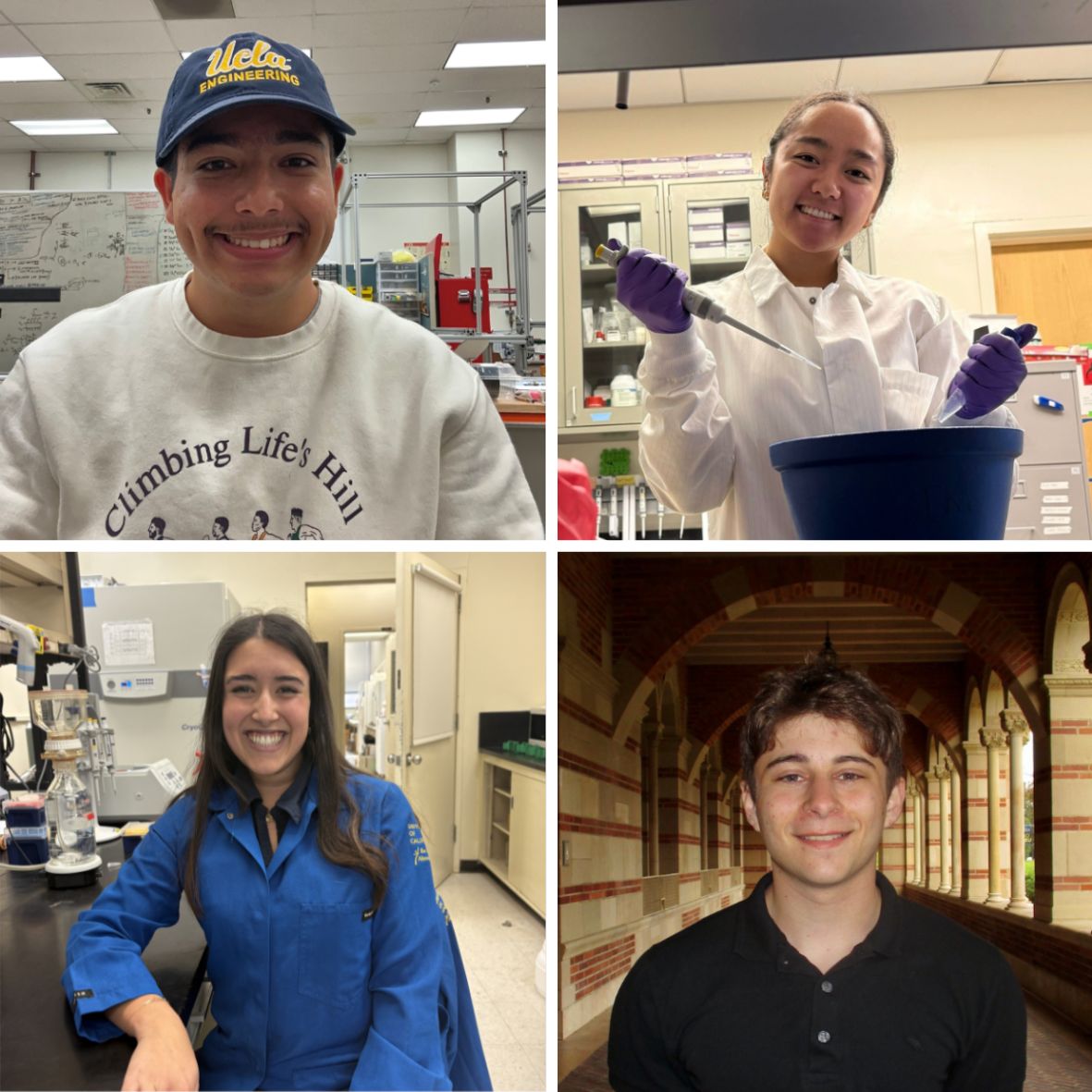

STUDENT SPOTLIGHT
Meet Robert Castillo! Robert is a third-year Mechanical Engineering and Education Studies double major looking to get a PhD in Nuclear Engineering to become a professor. He was previously involved in the Summer Undergraduate Research Program, hosted by the Henry Samueli School of Engineering and Applied Science, and the Summer Programs for Undergraduate Research, hosted by the Undergraduate Research Centers. Currently, Robert is a member of UC LEADS and is conducting research on the Solar Methane Pyrolysis Project, specifically designed to manufacture the next generation of graphitic carbon-carbon composites, as part of the Nano Transport Research Group under the direction of Dr. Timothy S. Fisher.
1. How did you first get involved in your research project? Tell us a bit about the lab you are in and the research you are conducting!
I am a part of the Nano Transport Research Group (NTRG) under the direction of Dr. Timothy S. Fisher and I work alongside my graduate student mentor, Benjamin T. Heronimus, on the lab’s Solar Methane Pyrolysis Project specifically designed to manufacture the next generation of graphitic carbon-carbon composites! Some applications of these types of C-C composites range from providing superior thermal management within aerospace vehicles in addition to serving as a carbon-neutral option for moderating materials in the next generation of nuclear reactors. My specific focus on this project centers on testing the final composites’ mechanical properties through tensile tests and material characterization, with the hope of one day incorporating indigenous Latin American weaving practices and ion-irradiation campaigns into the scope of the work.
I first got involved in my lab during the Winter Quarter of my first year at UCLA where it honestly took a lot of trial and effort to find the right fit, based both on personal circumstances and opportunities available. I had the chance to attend one of Professor Fisher’s office hour sessions early in the quarter to discuss possible research projects, and it was just a matter of filling out the lab interest form and connecting with Ben to get started on some exciting work!
2. How would you describe your research experience at UCLA?
I think my research experience here at UCLA has been nothing short of uplifting for not only my professional self, but my personal life too. As I started out at this university, I struggled with immense bouts of imposter syndrome and doubts about whether I could keep up with the rigor that is expected at UCLA; however, as my research has become more ingrained into my daily life as a student and I’ve had the chance to meet more researchers outside of my project or NTRG as a whole, I no longer experience these feelings of inadequacy to the same degree. Not to mention, being at the forefront of graphite research reveals a lot of machines and technology you didn’t even know existed, so my experience has been “world-opening” in that regard.
3. What is your year and major?
I am a third-year Mechanical Engineering and Education Studies double major.
4. What is one piece of advice you have for other students thinking about getting involved in research?
My one piece of advice for anyone wanting to get into research is to just apply to that lab or talk to that professor that conducts work you’re interested in no matter what. When I first started out in my lab, I knew absolutely nothing about graphite, composites, or many of the concepts involved in my work. When I applied to NTRG, I had just finished taking Pre-calculus and Introductory Chemistry, with no physics or engineering courses yet on my transcript. Over the course of time in your lab, you will pick up on the flow and procedures even without the contextual classes, so there’s no need to worry!
5. Have you attended a conference before? If so, can you describe your experience on preparation, presenting, etc.?
While I have not attended a conference before, I have presented at a physical poster symposium early on in my research journey. I honestly felt that the hardest part about that event was the amount of time needed to really flesh out my poster, both in content and layout, in a way that followed every requirement listed out by the program. There were a lot of weekly meetings about a month and a half before the symposium date to make sure we had work that fit the guidelines. I think this is good though, since you know that when it is time for the actual poster or vocal presentation, you have passed the hardest part of the entire process; your knowledge and confidence about your research will naturally seep through, even if you don’t realize it in the moment
6. Have you had your work published? Can you talk about what that process was like?
Yes, I was recently included as an author on a NTRG paper publication shared with my PI and my graduate student mentor about the mechanical properties of our carbon-carbon composites. Similar to preparing for a vocal or poster presentation, there is so much preparation to be done even before you begin the actual writing part. A substantial literature review of both current and foundational studies within your field not only makes up a lot of the introductory content, but also how you guide and present your writing later on in the paper. There were a lot of meetings between Professor Fisher, Ben, and myself to establish the narrative and messages we wanted to send through this research. Writing a paper grants you the unique opportunity to combine traditional writing with the world of scientific diagrams and figures to tell your research story, an aspect to this process that I found especially rewarding. I discovered that getting the initial manuscript ready for submission was only the first hurdle, and the review process can take a lot longer than you might first assume, a couple months after your initial submission, actually. It may seem like a lot of difficult work, and it is, but there really isn’t a better feeling than seeing your name on a publication just like the ones you read for your literature review.
7. What are your future career goals?
My future career goals involve getting a Ph.D. in Nuclear Engineering to become a professor in order to intersect my passion for engineering and education. I would love to continue my research interests in nuclear moderating materials to investigate ways to make our current and future fleets of reactors safer for all communities that they reside in.
8. Please list any URC/departmental programs you are/were involved in. How has your experience been in these programs?
I was previously involved in both the SURP and SPUR programs, and I am currently a member of the UC LEADS program that has led to my future involvement in UC Berkeley’s CalNERDS summer research experience. My work in the past two summers with the SURP and SPUR programs were instrumental for honing my skills as a researcher and becoming more connected to my project; learning presentation, poster-making, and experimental design skills are key components to my resume and overall skillset as a student. UC LEADS has provided me access to a plethora of resources surrounding how to become more resilient in the lab, research ethics, and best practices to promote minority success within STEM graduate programs. As I progress through UC LEADS, I know it will be instrumental to helping me apply to graduate school and remaining funded throughout my Ph.D. journey, in addition to the continuing the wonderful connections I have made with my cohort!
9. What was the impact of undergraduate research on your career path?
My experience within undergraduate research has not only molded my intentions to become a professor one day, but also has nailed down my specific interests within the broad field of nuclear energy. Without my time in NTRG and the Solar Methane Pyrolysis project, I do not think I would have as strong of an interest in graphite and carbon-carbon composites as I do now. Through research, I found the perfect way to combine my enthusiasm for engineering and education.

STUDENT SPOTLIGHT
Meet Amit Rand! Amit is a fourth-year Mathematics of Computation major currently conducting research in the Cardiovascular Imaging Research Lab (CVIRL). In addition, Amit was recently accepted into the Undergraduate Research Scholars Program (URSP), a three-quarter scholarship program that supports students who are conducting a life science, physical science, or engineering research project with a UCLA faculty. After completing his PhD, Amit hopes to work at a foundational research lab (industry or academia) focused on cutting-edge mechanistic machine learning, and eventually pursue entrepreneurship. Learn more about Amit and his UCLA research experience below.
1. How did you first get involved in your research project? Tell us a bit about the lab you are in and the research you are conducting (if possible)!
I joined the Cardiovascular Imaging Research Lab (CVIRL) under Prof. Kim-Lien Nguyen and Prof. J. Paul Finn at the David Geffen School of Medicine shortly after transferring to UCLA, and I’ve been in the lab since July 2024. I’m fortunate to be mentored by Dr. Kim-Lien Nguyen and her post-doctoral fellows, Dr. Thomas Coudert and Dr. Mostafa Mahmoudi, and to work with her collaborator, Prof. Dan Ruan, as part of a broader effort to accelerate MRI using machine learning.
A core challenge in MRI is that scans can be time-consuming, which often requires patients to hold their breath to reduce motion and improve image quality. Our long-term goal is to enable free-breathing MRI that improves the patient experience without sacrificing diagnostic fidelity. My work focuses on using generative modeling methods to reconstruct images from faster, more limited measurements. I initially joined the lab through a different project and later transitioned into this direction. Along the way, working closely with postdoctoral scholars and project scientists has been especially formative.
2. How would you describe your research experience at UCLA?
My research experience at UCLA has been incredibly positive and impactful. Through the Student Research Program (SRP), I have been able to dedicate structured, accredited time to research while staying on track academically. In addition to participating in SRP throughout the past year, this quarter I have been able to conduct full-time research through a 12-unit SRP enrollment, which has been especially aligned with my goal of pursuing a PhD. I have also felt strongly supported by mentors across the lab, including faculty, postdocs, and graduate researchers, who consistently make time to teach, give feedback, and help students grow.
Working in a clinical research environment has been uniquely motivating because I can see the real-world importance of the problems we’re solving and how they connect to patient care. I’ve also benefited a lot from URC resources and research-focused seminars, especially sessions that demystify topics like getting started in research and preparing for graduate school.
Additionally, I have felt supported more broadly within UCLA’s academic environment as I have pursued research. I have been fortunate to take multiple graduate-level courses through instructors’ consideration and encouragement, and those experiences have strengthened my technical foundation and clarified the research directions I want to pursue going forward.
3. What is your year and major?
Senior (Class of 2026) and Mathematics of Computation
4. What is one piece of advice you have for other students thinking about getting involved in research? As a transfer student yourself, do you have advice specific to other transfer students?
If you’re even considering research, try it. There’s no “perfect time” to start, and it’s often the best way to discover what you enjoy. Many faculty and labs are genuinely excited to mentor motivated undergraduates, especially when you reach out with a clear interest, willingness to learn, and commitment.
For transfer students specifically, leverage UCLA’s structured programs, especially URC Sciences, early, because they can accelerate your integration into the research community. And if it’s hard to get traction at first, don’t be discouraged. Reach out to postdocs and graduate students, too. They can often offer a smaller, well-scoped project that helps you build confidence, skills, and momentum toward a deeper research role. However, be mindful of postdocs’ and graduate students’ time, and always reach out to the Principal Investigator before starting any project.
5. Have you attended a conference before? If so, can you describe your experience on preparation, presenting, etc.?
I recently attended my first conference, The Thirty-Ninth Annual Conference on Neural Information Processing Systems (NeurIPS), where I presented a workshop paper. It was an amazing experience to be surrounded by experts in the field and to have so many conversations across a wide range of topics.
In preparation, I created my first poster, applied for grants to help cover the cost of attendance and travel, and made sure I could clearly explain my work. For presenting, it helps to have a strong two to five minute overview ready, then be prepared to answer questions and engage in deeper discussion. Most interactions move quickly, but the best conversations are with people working on closely related problems. I was fortunate to speak with teams from Microsoft Research, professors from Cambridge and Emory, and researchers at Toyota Research Institute about parallel ideas and directions.
One piece of advice I would carry forward is to attend the full conference if you can. Being there for the entire week makes a big difference for learning and networking.
6. Have you had your work published? Can you talk about what that process was like?
I have published a peer-reviewed workshop paper at NeurIPS as a co-first author, based on independent research with a peer.
The review process was a valuable first-time experience. I learned how to interpret reviewer feedback, respond thoughtfully to critiques, and iterate on the work to strengthen the final submission. Because NeurIPS workshops are peer reviewed, I was also assigned a few papers to review, which gave me experience seeing the process from the reviewer’s perspective and helped me better understand what makes a submission clear, rigorous, and compelling.
7. What are your future career goals?
After completing my PhD, I hope to work at a foundational research lab (industry or academia) focused on cutting-edge mechanistic machine learning, and eventually pursue entrepreneurship. I believe we are at the start of a major transition, and I want to help build the systems that will shape our world by making them safer, more reliable, while being grounded in the real-world. Longer term, I would also love to return to academia in a teaching-focused role at the university level.
8. Please list any URC/departmental programs you are/were involved in. How has your experience been in these programs?
This year (2025–2026), I have been part of the Undergraduate Research Scholars Program (URSP) Sciences, and I also took the RES PRC 194B graduate school application seminar.
URSP is a scholarship program and provides a strong support system. It supplies resources that make it easier to navigate research and build a clearer path forward to ultimately achieve your goals. One of the most memorable parts was access to the research practices courses (RES PRC).
The graduate school applications seminar with Dr. Hasson was especially helpful. The course is designed to help you build every component of a graduate application end-to-end, then refine it through structured feedback from peers and professors who have either gone through the process or are going through it alongside you.
9. What was the impact of undergraduate research on your career path?
Undergraduate research has been the main reason I am now committed to pursuing a PhD and building a long-term career in research. As a transfer student, my path into research was not straightforward, and community college made it clear how challenging it can be to access both research and industry opportunities. Over the past few years, I completed about five industry internships and three research experiences, which gave me a meaningful basis to compare the two.
While I initially expected to go directly into industry, my research experiences were more fulfilling on an intellectual and technical level, and they gave me a stronger sense of purpose and curiosity in my work. Ultimately, undergraduate research shaped my career direction by helping me realize that I want to contribute by doing deep, long-term research and mentorship in the field.

STUDENT SPOTLIGHT
Meet Henley Roy! Henley is a fourth-year Biochemistry and Business Economics major and has been involved in the URC – Sciences Summer Program and the Undergraduate Research Fellows Program (URFP). She is currently conducting research in the Petrovic Lab and works on examining nuclear import mechanisms of Yes-associated protein. In the future, Henley hopes to attend graduate school and obtain a research position in industry or academia.
1. How did you first get involved in your research project? Tell us a bit about the lab you are in and the research you are conducting!
I joined the Petrovic Lab in Fall of 2024 when the lab was just starting up! Currently the project I work on examines nuclear import mechanisms of Yes-associated protein (YAP1), which is a transcriptional coactivator that is dysregulated in triple negative breast cancer. This protein is too large to enter the nucleus through passive diffusion, but also lacks a canonical nuclear localization signal (NLS) typically required for active transport by importin proteins, making its import mechanisms unclear. To study this pathway, I have expressed and purified protein constructs of YAP1 and candidate importin protein interactors, and I am testing binding interactions between these proteins.
2. How would you describe your research experience at UCLA?
My research experiences at UCLA have been an amazing learning experience. My graduate student mentors and PI’s have taught me many fundamental technical wet lab skills, but also how to practice scientific communication and proposal writing which are important for a wide variety of future career trajectories.
3. What is your year and major?
4th year, Biochemistry and Business Economics major
4. What is one piece of advice you have for other students thinking about getting involved in research?
If you are thinking about getting involved in research do it! The only way you can know if you like it or not is if you try it.
5. What are your future career goals?
I hope to attend graduate school and conduct research in Protein Biochemistry/Structural Biology, and eventually obtain a research position in industry or academia.
6. Please list any URC/departmental programs you are/were involved in. How has your experience been in these programs?
I was involved in the URC Summer Sciences program as well as the URFP program. These programs have provided me invaluable guidance and mentorship, as well as financial support which allows me to focus more time on my research.
7. What was the impact of undergraduate research on your career path?
My experiences in undergraduate research set me on the trajectory of applying to PhD programs in Biochemistry, which is something I never thought I would do coming into college. They helped me realize how much I love working in a lab and working with other scientists!

STUDENT SPOTLIGHT
Meet Cara Susilo! Cara is a fourth-year Bioengineering major, currently conducting research at the Kamariza Lab focusing on protein engineering with Cas enzymes, and culturing and extracting genomic DNA from non-tuberculous myobacteria. Cara has attended several national conferences, including the Biomedical Engineering Society Conference and the American Society for Microbiology Conference, and was recently published as a second author on her lab’s first publication. Read Cara’s full interview below.
1. How did you first get involved in your research project? Tell us a bit about the lab you are in and the research you are conducting (if possible)!
I became involved in research during Winter Quarter of my freshman year where I joined the Kamariza Lab in the Bioengineering Department. For most of my time, I worked on project demonstrating how solvatochromic trehalose probes can not only detect drug resistant tuberculosis, but differentiate between susceptible and resistant TB using a plate reader as a low cost and point-of-care friendly readout. I was also fortunate to join this project from its inception all the way to publication, and as one of the first members of the Kamariza Lab, I have had the pleasure of watching it grow! Today, I’m working on two new projects, specifically focusing on protein engineering with Cas enzymes, and culturing and extracting genomic DNA from non-tuberculous mycobacteria. Our lab is incredible diverse and supportive, and the graduate students do an amazing job ensuring undergrads have quality mentorship.
2. How would you describe your research experience at UCLA?
My research experience has been incredibly positive. I was able to strengthen technical skills and solidify my own research drive as I worked throughout the year, and opportunities to present within my department and during Undergraduate Research Week has been helped me in this process. The support I received from my department and URC has significantly impacted my experience, and I am thankful for the opportunities I’ve had throughout the last four years!
3. What is your year and major?
Fourth year Bioengineering
4. What is one piece of advice you have for other students thinking about getting involved in research? As a transfer student yourself, do you have advice specific to other transfer students?
Don’t be afraid to put yourself out there and send that cold email! Research gives so much more than just technical skills, you also learn how to do data analysis, develop scientific literacy skills, and participate in science on such a hands-on level. Show your passion and willingness to learn, and the opportunity will come to you.
5. Have you attended a conference before? If so, can you describe your experience on preparation, presenting, etc.?
I have attended several national conferences including BMES and ABRCMS. Preparing the poster or oral presentation is sometimes challenging, but you get to really understand the science as you make it. For poster sessions, a lot of grad students and even professors stopped by. It was slightly intimidating at first, but I ended up connecting with other exciting undergrads and people in academia at all levels. They also gave really helpful feedback on presenting and also other possible experiments which I could bring back to the lab.
6. Have you had your work published? Can you talk about what that process was like?
I recently published as a second author on our labs first publication! The majority of the process was spent performing experiments, discussing the data, and performing follow-up experiments. As my grad student was writing the manuscript, I helped write a couple of the methods and captions, and helped proofread before we submitted. I also performed some of the revision experiments. While there were many late nights and early mornings, seeing the publication accepted made the work worth it.
7. What are your future career goals?
I hope to go to graduate school to pursue a PhD in Bioengineering or Chemical Engineering. Afterwards, I plan to enter the biotechnology industry as a scientist.
8. Please list any URC/departmental programs you are/were involved in. How has your experience been in these programs?
During the summer of my freshman year, I participated in the URC Sciences Summer Program which funded summer research. In the spring of my second year, I was awarded the UC LEADS Fellowship. With their support, I could continue developing other essential research skills, and participated in the Summer Research Training Program at UCSF this past summer as part of their second summer.
9. What was the impact of undergraduate research on your career path?
Prior to joining a lab, I was less inclined to pursue graduate school and wanted to go straight into industry. But throughout the past couple of years, I found value in graduate school, especially in further specializing within bioengineering, and refining scientific skills on the bench. I’ve gained an appreciate for graduate work as well, and in seeing my own grad student’s experiences, I have been inspired to go to the next level.
These student highlights were published by the University of California – Los Angeles (UCLA). Find the original article by clicking on the researcher’s name in the article.
Founded in 1978, the Council on Undergraduate Research (CUR) focuses on providing high-quality and collaborative undergraduate research, scholarly, and creative activity. Among the many activities and networking opportunities that CUR provides, the organization also offers support for the professional growth of faculty and administrators through expert-designed institutes, conferences, and a wide-range of volunteer positions. The CUR community, made up of nearly 700 institutions and 13,000 individuals, continues to provide a platform for discussion and other resources related to mentoring, connecting, and creating relationships centered around undergraduate research. CUR’s advocacy efforts are also a large portion of its work as they strive to strengthen support for undergraduate research. Its continued growth in connections with representatives, private foundations, government agencies, and campuses world-wide provides value to its members and gives voice to undergraduate research. CUR is committed to inclusivity and diversity in all of its activities and our community.
CUR focuses on giving a voice to undergraduate research with learning through doing. It provides connections to a multitude of campuses and government agencies, all while promoting networking and professional growth to its community.
