A draft of May Swenson’s iconograph “The Bottle.” (May Swenson papers, USU_COLL MSS 282. Special Collections and Archives. Utah State University Merrill-Cazier Library. Logan, Utah.)
May Swenson (1913-1989) is widely celebrated as one of the best-known poets of the 20th century, with 59 poems published in The New Yorker, several books of poetry, and a nine-year service as chancellor of the Academy of American Poets.
Now student researcher Brook Haight is exploring an overlooked part of Swenson’s legacy: her unpublished artwork. This research highlights how Swenson’s creativity extends beyond her poetry, and to view her as only a poet is to miss a valuable aspect of her creative vision.
Born and raised in Logan, Swenson attended Utah State University and majored in English. Perhaps as integral to her education and creative process was her minor in art. Swenson was not just a master of language — she was an artist of words, shaping them in both meaning and in form. Swenson is known for her innovative use of concrete poetry, where the formatting of the words arranges an image that deepens the poem’s impact.
Haight, a creative writing major at USU, began viewing Swenson’s artwork while in an upper-division archival research class. While looking through the Swenson collection in USU’s Special Collections and Archives, she found a drawing of a cat titled “Boa.”
“It was this really interesting connection, because [art] isn’t something I usually see when researching poets,” Haight said. “May Swenson has a poem titled ‘Sleeping with Boa’ and one called ‘Drawing the Cat,’ so when we made that connection to the drawing, it felt really cool.”
May Swenson’s drawing of Boa. (May Swenson papers, USU_COLL MSS 282. Special Collections and Archives. Utah State University Merrill-Cazier Library. Logan, Utah.)
This discovery, along with Haight’s professor Christine Cooper-Rompato, prompted her to apply for a scholarship from The Cache Valley Historical Society, which allowed her to continue her research on Swenson’s unpublished artwork.
“You see so many similar topics in her art to what she’s writing about,” Haight said.
Another correlation between Swenson’s art and poetry can be found between her poem “Orbiter 5” and a collage from Washington University Archives. “Orbiter 5” is shaped like the earth from space, and the collage features her supposed inspiration photo for that iconograph. The work includes assorted newspaper clippings and art, which tell their own story. Also found in USU Special Collections and Archives is an image and newspaper clippings of a DNA strand, the inspiration for Swenson’s poem “The DNA Module,” which is shaped like a double helix.
“It gave me more insight into her process,” Haight said. “So much of her process is observational, and it’s not just describing something in words only. It was about getting the shape or the color, like with the collage poems.”
While the reasons why Swenson’s artwork was never published are speculative, Haight believes it may have to do with how artists are viewed as a whole.
“While explaining my research to the executor of Swenson’s estate, they responded, ‘May Swenson is a poet, not an artist.’ But just because she didn’t professionally draw these things doesn’t make her less of a visual artist,” Haight said. “A lot of people want to put artists in a box and ascribe whatever you do professionally as the only creative thing you do. … When we engage with artist’s art in that way, we’re depriving ourselves as an audience.”
Cooper-Rompato sees this research as an expansion of Swenson’s legacy.
“One of the biggest contributions of this research is thinking about May Swenson as a visual poet, beyond her concrete poems,” she said.
Haight will present her research for the Cache Valley Historical Society and community members at 7 p.m. April 9 at the Logan Library. This is in addition to an event planned at Swenson Park later this spring.
“May Swenson did so many interesting and innovative things with her poetry that to not look at other elements — especially if you are truly and earnestly trying to understand what she was writing about — cuts yourself off a whole section of understanding,” Haight said.
Written by Vanessa Richards for Utah State University; used with permission. Find the original article here.
Clad in hip waders, the weight of the cool river flow buffeting the protective layer keeping him dry while immersed in the science of salmon enhancement is exactly where Tristen Dieleman wants to be.
Tristen is a second-year diploma student in the VIU Fisheries and Aquaculture program. He came to the university as a mature student, knowing that a career in fisheries was where he wanted to be.
“If you’re passionate about whales, wolves, bears or trees, you have to get passionate about salmon because the nutrients from salmon feed that entire ecosystem,” says Tristen. “All of it depends on the salmon that head into a great big ocean when they are only inches long. They feed other creatures, feed us, the ones that survive come back to the river, feed more animals, spawn, die and nourish the environment. It’s an amazing process.”
His experience working in a local river this past fall is helping Tristen define his career path.
Under the direction of Professor Duane Barker, Tristen participated in a chum and coho salmon counting assessment on the Chase River in south Nanaimo that yielded startling results.
Four teams of students collected data from specific sections of the river. They measured the velocity and discharge of their section of the stream, assessed overhead foliage and counted the number of salmon swimming upriver to spawning grounds.
“Something spectacular happened last year,” says Tristen. “2024 was a record-breaking chum salmon return. We estimated the escapement for chum salmon to be 5,624, while for coho salmon, it was 1,136. The fact we’re getting returns such as this in a system suffering from anthropogenic effects from human development is huge.”
The estimated escapement returns for chum salmon in 2024 were 5 to 7 times higher than the last decade since monitoring by VIU students began in 2011, and the coho salmon returns observed were 3 to 7 times higher than the past two decades since monitoring began in the 1990’s.
All data collected by the four teams at the end of the salmon run was collated and analyzed by the students to determine the environmental conditions that triggered the salmon migration.
“Tristen was a true leader. He helped train new students on all sampling procedures, was responsible for compiling all field data and served as liaison between his team and I,” says Duane. “This was a great training opportunity for Tristen to further develop skills in leadership, organization and communication and he excelled.”
Duane shares the data with the Department of Fisheries and Oceans (DFO).
“Last semester, the returns were so good that our results were published in the DFO salmon escapement bulletins to showcase how well our rivers do,” says Tristen. “DFO uses that data for management plans.”
Duane says this field training helps develop a sense of habitat stewardship among students. They learn the importance of monitoring and maintaining critical physical features of an urbanized stream.
“Many students are surprised that an urbanized stream could contain different species of spawning salmon,” he says. “They soon understand the importance of conserving such habitats. They understand the importance of the types and amount of vegetation around a stream and in-stream features like logs, pools and riffles.”
Tristen says the fieldwork helped him develop competence as a leader managing a team as well as skills in data computation such as estimating discharge and flow levels and how that affects rivers, all applicable to working in the sector after graduation.
“Where do I want to go after graduation is a great question,” says Tristen. “There are opportunities for a career in fisheries and aquaculture around the world.”
Originally, Tristen thought working with freshwater trout was where he would end up, but that changed as he journeyed through the diploma program.
“As I’ve gone through the program and learned what I’ve learned, I’ve realized what I don’t know is even greater; you realize you don’t know 10 other things,” he explains. “One thing for certain is regardless of where I end up, I’m going to enjoy it. Because I’ve enjoyed the entirety of the program since I have been here. Every course has information relevant to what I enjoy in life and my passion. As long as there are fish, that is where I will be.”
Written by Annette Lucas for Vancouver Island University; used with permission. Find the original article here.
Whether online or in person, undergraduate students of Arizona State University’s School of Human Evolution and Social Change have many opportunities to engage in real-world research through collecting, managing, analyzing and cleaning data.
Two recent publications led by Alissa Ruth, director of strategic initiatives at the school, use mixed-methods data collection and analysis to show how undergraduate research experiences (UREs) benefit undergraduate students and mentors.
Over the past 13 years, 1,300 students at the school have participated in various UREs. Faculty in the school are studying how these social science UREs compare with UREs that have been historically offered in STEM fields.
The researchers studied how three different UREs compare. They examined course-based undergraduate experiences (CUREs), individual research experiences (IREs) and lab-based undergraduate research experiences (LUREs).
In the publication “Laboratory-Based Undergraduate Research Experiences (LUREs): Evidence of Effectiveness from the Social Sciences,” Ruth and co-authors found that lab-based experiences in the social sciences for undergraduates were perceived to be slightly more effective than other types of undergraduate research experiences for skill development.
“Our team is one of the first to actually test the benefits of a social science lab,” Ruth said. “There are some faculty in the social sciences who have talked about the importance of the lab as a center for training — but here our team actually collected data on what we do in the lab and the impact participation in a LURE has on student training.”
Ruth elaborated on why this might be:
“Lab-based undergraduate research experiences include people who have varying levels of expertise. It’s a very collaborative environment with many different projects going on. As students stay in the lab, ideally they get more and more evolving tasks that keep honing their skills and they can, in turn, help out each other and train new students.”
Students who completed a CURE with Alissa Ruth presented their research findings at the annual undergraduate research symposium. Photo by Alissa Ruth.
Research apprenticeship program
In 2011, the School of Human Evolution and Social Change created the Undergraduate Research Apprenticeship Program (RAP) so that undergraduates could easily connect with UREs.
The program offers both online and in-person students course credit and research experience in archaeology, bio-archaeology, environmental social science, evolutionary anthropology, global health and sociocultural anthropology.
Another paper, “Research supervisors and undergraduate students’ perceived gains from undergraduate research experiences in the social sciences” — led by Ruth — highlights the benefits of UREs on both students and research mentors who provide UREs.
They found that students gain data collection, management and analysis skills, as well as learn to collaborate, manage time and solve problems. Research supervisors feel a sense of job satisfaction and enjoy mentoring students, while junior scholars are able to develop their mentorship and student supervision skills, Ruth said.
“In a big program, with lots of students and a research-oriented faculty, this is probably the best way for students to get individual attention and to learn about the process of research,” said Michael Smith, professor of archaeology, co-author of the recent papers and director of the Teotihuacan Research and Mesoamerican Archaeology laboratories.
Students who work in the Teoihuacan Research Laboratory pose with Professor Michael Smith (far left) and a poster board showing what they learned and researched during their lab experience. Photo courtesy of the School of Human Evolution and Social Change.
Ella Zeiders is an undergraduate anthropology student and has been working on projects within the Teotihuacan Research Laboratory, as well as the Archaeological Collections Care and NAGPRA internship program at the Center for Archaeology and Society repository.
“The Maya sustainability project has taught me to research effectively, read academic articles well, conduct exploratory data analysis and collaborate on a research team while under the supervision of an experienced professor,” Zeiders said.
“With the collections care experience, I was given hands-on experience inventorying anthropological collections and learning about federal compliance for the Native American Graves Protection and Repatriation Act (NAGPRA). In my experience, projects like these are invaluable in that they allow students to apply and grow skills that can’t necessarily be developed in a classroom.”
Angela Ho is an online undergraduate anthropology student who is currently living in South Korea. She has participated in three RAP opportunities. In her first experience, she learned to transcribe papers on Filipino folklore, tribe stories and economics into digital form.
She also participated in the “Whaling Governance in Alaska: Using social networks to understand co-management practices over time” apprenticeship with Associate Professor Shauna BurnSilver.
“Through this apprenticeship, I learned how the Alaska Eskimo Whaling Commission (AEWC) has fought for their whaling sustenance rights, what entities they interacted with along the way and how their role has changed. I also learned the history of Alaskan Native Americans, what animals Alaskan Native Americans eat and how they distribute it to other areas. I was delighted to take part in this project because I acknowledge the efforts of AEWC, which has successfully raised the quota of whale hunting and helped it stay that way by collaborating with researchers, governments, agencies and Native communities.”
Ariana Jackson is an in-person undergraduate anthropology student who participated in the Culture, Health, and Environment Lab (CHELab) through the RAP program and is currently applying for graduate school.
CHELab end-of-semester celebration with faculty and students. Photo by Alissa Ruth.
“The Culture, Health, and Environment Lab was an amazing opportunity to experience firsthand the intersections between culture and health,” Jackson said. “In the lab, we used social science methods to analyze qualitative data to better understand how marginalized groups in varying regions face negative health implications. This experience allowed me to gain research experience in my field of global health, and additionally allowed me to form connections with faculty like Alissa Ruth, which led to other research opportunities.”
Online training for UREs
The school’s faculty are engaging in new and innovative UREs through The College of Liberal Arts and Sciences Online Undergraduate Research Scholars program (OURS). This program was the recipient of the 2023 President’s Award for Innovation.
Among those recognized from the School of Human Evolution and Social Change were Associate Professor Emir Estrada, for her Arizona Youth Identity Project; and Ruth, Regent’s Professor Alexandra Brewis, Professor Cindi SturtzSreetharan and President’s Professor Amber Wutich, for their Social Research Training (SoRT) program. SoRT grew out of the CHELab and offers students credit and high-quality training in qualitative and cross-cultural data collection and analysis.
“Oftentimes in liberal arts education, many people ask the question, ‘Well, what can you do with this degree?’” Ruth said.
“We know that students gain valuable skills by earning a liberal arts degree, such as communication, critical thinking, writing, speaking, teamwork and so on. However, when you have research experience, you are getting a different skill set through hands-on experiences and learning about how to collect valid data and analyze it systematically so you can make evidence-based recommendations. These skills are highly sought in various careers.
“Moreover, students in UREs connect with faculty and fellow students in a different way than in the traditional classroom, and these connections are important for feelings of belonging and finding out about other opportunities. This is why UREs are high-impact practices and why our faculty and school is committed to continuing to provide wide access to these experiences.”
Written by Nicole Pomerantz for Arizona State University; used with permission. Find the original article here.
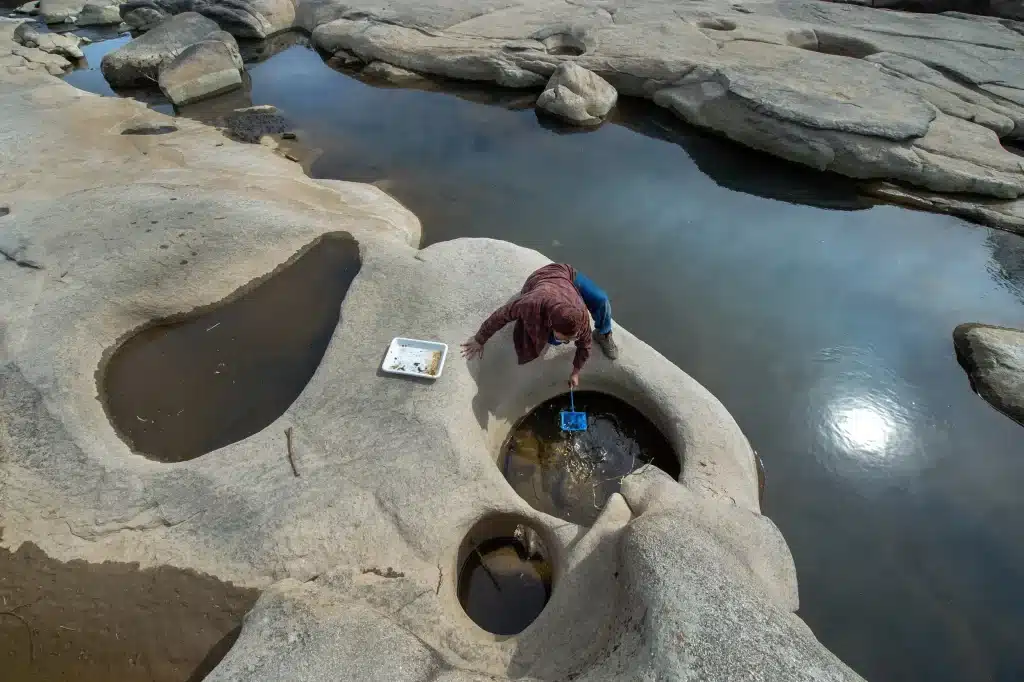
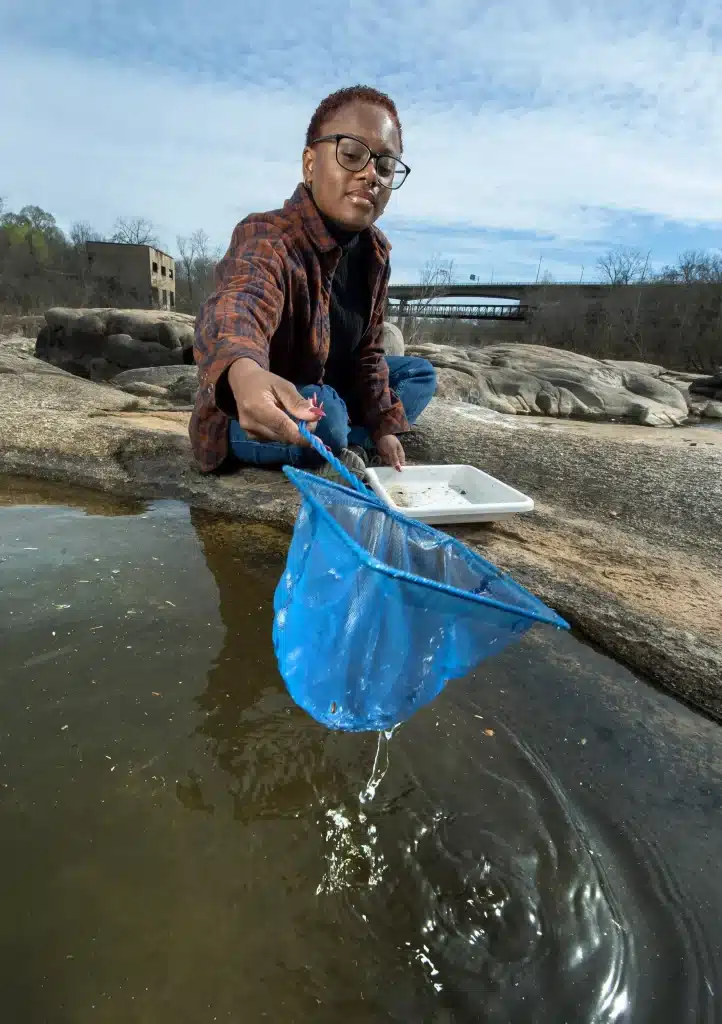
Jennoa Fleming, a senior environmental studies major at VCU, researches the James River rock pools, focusing on a small aquatic snail. (Kevin Morley, Enterprise Marketing and Communications)
Jennoa Fleming once thought she wanted to be a doctor. However, the lure of ecology and the macroinvertebrates that fascinate her eventually drew her away from a pre-med path.
She discovered her interest in ecology as a student at Open High School near the Virginia Commonwealth University campus in Richmond when she joined a VCU-led research project at the rock pools on Belle Isle alongside the James River. Now a senior at VCU majoring in environmental studies in Life Sciences and minoring in biology in the College of Humanities and Sciences, Fleming is still studying those same pools – and finding their small, vibrant worlds as compelling as ever.
She spoke to VCU News about her research journey and why she’s grateful for it.
Tell us the focus of your research … and why it is important/impactful for all of us.
I study James River rock pools, which are holes formed in the granite slabs along the river, creating small mesocosms that allow aquatic plants, macroinvertebrates and other organisms to thrive in pond-like ecosystems. My research focuses on how aquatic macroinvertebrates interact with each other and other factors in these pools. My specific research topic is how the aquatic snail, Physa acuta, is affected by the presence of cigarette butt leachate in its environment.
What inspired you to pursue this line of research?
I’ve always been interested in the environment and animals, all of my favorite childhood shows were about animals, like “Zoboomafoo.” When I was in high school, I was told about a summer science program by my biology teacher. I didn’t know too much about it except that I would be outside a lot and I would get $500, so I was interested. In this program, I worked with different ecologists, specifically James Vonesh, Ph.D., a professor in the Center for Environmental Studies at VCU who studies the rock pools, and students from VCU and the University of Richmond. We took occupancy data of the pools and looked at the different organisms in each pool and pondered what factors could affect them. From this, I developed a research project with two of my peers, and we presented our findings at a conference.
Jennoa Fleming understands the importance of studying macroinvertebrates, the foundation of our ecosystem. “We are all interconnected,” she said. (Kevin Morley, Enterprise Marketing and Communications)
Tell us about a surprise in your research journey.
A surprise in my journey was when I applied to a summer class, Footprints on the James. In this class, students travel along the James River for a month studying the organisms within the environment, the history of the river and freshwater sciences. At the info meeting I met James Vonesh again. He recognized me and the work we’d previously done together when I was in high school, which changed the trajectory of my academic career. Prior to this meeting, I was on a pre-med track, but through this, I ended up switching to environmental studies and biology and was able to join Dr. Vonesh’s lab to continue the research I did prior to college.
Tell us about an obstacle or challenge you had to overcome in your work.
I’ve had a rocky background before I started college including the loss of a parent and growing up in poverty, so it can be very hard to figure out what the purpose of me doing research is. It’s easy to convince yourself when you have these experiences to simply go after what will make you rich instead of what your passions are. I started off on the pre-med track and tried to convince myself that I’d be happy doing it, but the subject didn’t interest me. During my undergraduate career, I have wrestled with this, but ecology is truly where I belong. It’s so engaging to me, and I can’t imagine doing anything else.
Is there a memorable partnership or lesson you’ve embraced along the way?
Other than my mentor James Vonesh, a memorable partnership I’ve made was with Catherine Hulshof, Ph.D., an associate professor of biology. At VCU, I am the president of SEEDS for the 2023-2024 academic year, which is a VCU student club with a mission to promote diversity within the field of ecology. Through this club, I am able to share my experiences in ecology as well as learn so much. Dr. Hulshof studies plant and tropical ecology, as well as how biodiversity is being affected by climate change. Dr. Hulshof has been a consistent support system for me, and I am inspired by her passion for diversity in ecology.
What do you find fulfilling about the research process?
What I most find fulfilling about the research process is just how much information we still don’t know yet. Throughout human history, we have gained so much general knowledge but there is so much we have yet to explore, and this is especially true for the field of ecology. More importantly, with the onset of climate change we are very unsure about how humans will be affected, much less the organisms that reside alongside us. Other species may seem unimportant, such as macroinvertebrates, but they are the foundations of our ecosystem. They are our food sources, our oxygen suppliers, our waste decomposers, and so much more; we are all interconnected. Continuing to research information about our ecosystems will help us in the long run and help us understand what factors affect them as well as us. Knowing that my research could help provide insight into what our future may look like is very fulfilling.
What advice would you offer undergrads to kick-start their own research journeys?
I would recommend undergraduates interact and engage with their professors that study topics that interest them. Many of the professors at VCU are passionate about their subject matter, and they would love to discuss research questions you may have. Whether it’s to welcome you into their lab or it’s them pointing you in the direction of external resources, your professor likely has many opportunities that fit your interests. Also, I recommend exploring elective courses that interest you. Even though you may not need specific courses to graduate, it’s important to explore your field of study and find what you like. You will likely develop professional relationships with your professors this way and gain more access to research opportunities.
Written by Tom Gresham for Virginia Commonwealth University; used with permission. Find the original article here.
Dr. Olivia Carr Edenfield, Director of the American Literature Association and Professor in the Department of English at Georgia Southern University, has been selected as the 2025 Council on Undergraduate Research (CUR) – Arts and Humanities Faculty Mentor Awardee.
Dr. Olivia Carr Edenfield is an esteemed professor and mentor known for her dedication to undergraduate research in the arts and humanities. As a faculty member who has mentored over 50 undergraduate students, she has made significant contributions to student mentorship, guiding undergraduates in scholarly research, writing, and professional development. Edenfield has been instrumental in fostering research opportunities in and outside the classroom, including serving with the American Literature Association, where she helped create opportunities for students to engage in scholarly discussions and research dissemination. Many of her students have presented at national and regional conferences, demonstrating the impact of her mentorship in shaping future scholars.
According to Georgia Southern University’s President, Kyle Marrero, “Congratulations to Dr. Edenfield on this significant recognition by the Council on Undergraduate Research. Her exemplary dedication to fostering a culture of curiosity, creativity, and scholarly excellence will continue to help our students and the University’s undergraduate research enterprise reach new heights.”
Explains Edenfield, “I have been a university faculty member for decades, and nothing has provided me with more satisfaction and pride–more pure, unbridled joy–than my students’ myriad successes these 39 years. The Council for Undergraduate Research Arts and Humanities Faculty Mentor Award encapsulates my highest priority as a university professor: helping my students thrive. I am deeply blessed and incredibly honored to receive this award.”
Lindsay Currie, CUR’s executive officer stated, “Dr. Olivia Carr Edenfield exemplifies the very best in undergraduate research mentorship. Her dedication to guiding students through meaningful scholarly experiences in the humanities has made a lasting impact on their academic and professional journeys. Through her leadership, commitment, and passion for student success, she has not only elevated undergraduate research at Georgia Southern University but also contributed significantly to the broader academic community. We are proud to recognize her with the CUR Arts and Humanities Faculty Mentor Award for her outstanding contributions to student mentorship and research.”
The CUR-Arts and Humanities Faculty Mentor Award was established in 2018 through an endowed gift by 2012 CUR Fellow Joyce Kinkead (Utah State University) to nurture undergraduate research, scholarship, and creative inquiry in arts and humanities disciplines. Carr Edenfield will be honored at the June 10, 2025, CUR Award Celebration.
Founded in 1978, the Council on Undergraduate Research(CUR) is an organization of individual, institutional, and affiliate members from around the world that share a focus on providing high-quality and collaborative undergraduate research, scholarly, and creative activity opportunities for faculty and students. Nearly 700 institutions and more than 13,000 individuals belong to CUR. CUR believes that faculty members enhance their teaching and contribution to society by remaining active in research and by involving undergraduates in research, and that students engaged in undergraduate research succeed in their studies and professional advancement.
Georgia Southern University, a public Carnegie Doctoral/R2 institution founded in 1906, offers approximately 155 different degree programs serving more than 26,100 students through 10 colleges on three campuses in Statesboro, Savannah, Hinesville and online instruction. A leader in higher education in southeast Georgia with expert faculty, the University is focused on public impact research and engaging learning opportunities through knowledge and know-how that prepare our students to take ownership of their lives, careers and communities.
CUR congratulates Amelia Ahern-Rindell (University of Portland) and Winny Dong (California State Polytechnic University – Pomona) as they are appointed a 2025 CUR Fellow. The CUR Fellows Award for Excellence in Undergraduate Research Leadership annually recognizes a CUR member who is a leader and role model within the undergraduate research community and whose career represents the values and ideals represented in CUR’s Characteristics of Excellence in Undergraduate Research. Drs. Ahern-Rindell and Dong are to be honored for their leadership and service as role models for those involved in undergraduate research, scholarship, and creative activities. Both will be celebrated during a virtual Award Ceremony on Tuesday, June 10, 2025. You can RSVP to the ceremony here.
Dr. Amelia Ahern-Rindell, University of Portland
“Dr. Ahern-Rindell’s unwavering dedication to undergraduate research and mentorship has profoundly shaped both her students and the broader academic community,” said Lindsay Currie, CUR’s executive officer. “Her selection as a CUR Fellow is a well-earned recognition of her tireless efforts to expand research opportunities, foster a culture of inquiry, and champion innovation in undergraduate education. Even in emeritus status, her commitment remains evident through her contributions to advancing best practices, including her work on Probing Faculty, Student, Disciplinary, and Institutional Influences: CUR Transformations Project. Her legacy of mentorship and advocacy will continue to inspire and empower future generations of researchers.
Ahern-Rindell is a recipient of several research and mentor awards including the University of Portland’s Mentor of the Year Award (2022) and Provost’s Council Award for Exhibiting Excellence in Advising and Mentoring (2018), the Sigma Xi National Honors Society Columbia-Willamette Chapter’s Outstanding Faculty Established Researcher Award (2021), and CUR’s Biology Division Faculty Mentor Advanced Career Award (2019). Amongst the many honors, Ahern-Rindell has been featured in cover stories, published opinion pieces, peer-reviewed articles, and co-authored publications with research students. She remains an advocate for undergraduate research through her continued involvement with many member organizations, but also on campus supporting the infrastructure and programs of research, acquiring funds that have been instrumental to the success of many programs, such as the University of Portland’s Summer Undergraduate Research Experience (SURE). Ahern-Rindell’s dedication to inclusive mentorship and high-impact research experiences has left a lasting impact on both students and faculty colleagues. As she transitions into emerita status, her legacy continues through the programs she helped establish, the students she inspired, and the broader academic community she enriched.
“The University of Portland community is very proud that Associate Professor Emerita Dr. Ami Ahern-Rindell has been recognized as a CUR Fellow,” states Dr. Megel, University of Portland’s provost. “During more than 25 years at UP, Dr. Ahern-Rindell effectively supported undergraduate students to conduct research. She personally mentored more than 100 research students in her genetics lab, many of whom went on to medical and other graduate school programs. Dr. Ahern-Rindell also advocated successfully for the expansion of research opportunities for undergraduates in all disciplines at UP. She was instrumental in establishing college and university-wide programs that continue to provide high-impact experiences for many undergraduate students within and beyond the natural sciences. The University of Portland thanks Dr. Ahern-Rindell for her dedication to our students and congratulates her on this prestigious award.”
Ahern-Rindell states, “I am thrilled to be one of the 2025 recipients of the CUR Fellows Award. Over the years, I have learned much from my CUR colleagues and have been in awe of their dedication to Undergraduate Research, Scholarship and Creative Inquiry. I have shared this knowledge with my University of Portland colleagues, and I am pleased with what we have accomplished to make a thriving and impactful campus-wide undergraduate research program. Most of all, I am grateful for the many years I have spent with my student collaborators in the lab conducting research together.”
Dr. Winny Dong, California State Polytechnic University – Pomona
“Dr. Winny Dong’s dedication to undergraduate research and mentorship has been truly transformative, providing students with invaluable opportunities to engage in hands-on learning and scholarly exploration,” said Lindsay Currie, executive officer at CUR. “Her leadership in fostering curiosity, innovation, and academic excellence has empowered countless students to reach their full potential. In addition to her mentorship, Dr. Dong’s contributions as editor of Characteristics of Excellence in Undergraduate Research have helped shape best practices in undergraduate research, further strengthening the foundation for future scholars. Being named a CUR Fellow is a well-earned recognition of her profound impact on undergraduate research and her tireless efforts to support and inspire the next generation.”
Over the past 24 years, Dong has mentored over 200 students directly, with a significant focus on supporting first-generation, low-income, and historically underserved students. Her mentorship has resulted in outstanding student success rates, with 98% earning a bachelor’s degree, 34% a master’s, and 13% a Ph.D.—far exceeding institutional averages. Beyond direct mentorship, Dong has created and sustained multiple undergraduate research programs, impacting over 5,000 students through scholarships, research experiences, and conference opportunities. As the founding director of the Office of Undergraduate Research at Cal Poly Pomona, Dong has led several initiatives to secure grant funding to support research programs. Recognized nationally, she was honored with the Presidential Award for Excellence in Science, Mathematics, and Engineering Mentoring by NSF and the White House in 2021. Through her work, she has demonstrated that undergraduate research is a powerful tool for student success and equity, ensuring that all students—regardless of background—can envision and achieve ambitious futures.
According to Cal Poly Pomona’s provost, Terri Gomez, “Winny Dong has an unparalleled record of championing undergraduate research at Cal Poly Pomona. Her leadership in founding multiple programs at our university and advocacy for undergraduate research has changed the lives of thousands of students, who, without her vision, may never have been exposed to the opportunities this high-impact practice provides. We are so proud of Dr. Dong and her achievement.”
“I am deeply grateful to the Council on Undergraduate Research for the role it has played in my professional growth, in connecting me with like-minded mentors, and in the leadership opportunities it has provided,” explains Dong. “Receiving the CUR Fellows Award is a true honor. I have witnessed how undergraduate research experiences can transform students – providing them the confidence, skills, and support they need to succeed in school and beyond. Being part of the students’ journeys is what motivates me to continue to grow my mentoring practice, create undergraduate research opportunities, and support others who are passionate about mentoring. This award also highlights the supportive environment at Cal Poly Pomona and the amazing students it serves.”
Founded in 1978, the Council on Undergraduate Research(CUR) is an organization of individual, institutional, and affiliate members from around the world that share a focus on providing high-quality and collaborative undergraduate research, scholarly, and creative activity opportunities for faculty and students. Nearly 700 institutions and more than 13,000 individuals belong to CUR. CUR believes that faculty members enhance their teaching and contribution to society by remaining active in research and by involving undergraduates in research, and that students engaged in undergraduate research succeed in their studies and professional advancement.
Cal Poly Pomona is the No. 1 polytechnic university for diversity and economic mobility, recognized for helping students from all backgrounds improve their financial futures and achieve their dreams of career success. CPP is nationally ranked as one of the top public universities in the West (U.S. News & World Report), among the best colleges in America (The Wall Street Journal) and a “best bang for the buck” (Washington Monthly). With eight academic colleges, CPP offers hands-on learning inside and outside the classroom in more than 100 undergraduate and graduate degree programs. Founded in 1938, it is the largest of three polytechnic universities in the California State University — the largest four-year public university system in the United States. Of the more than 27,000+ students served by CPP, most are the first in their families to attend college, and more than two-thirds receive financial aid. With a unique agricultural heritage and desirable geographic location in sunny Southern California near vibrant Los Angeles, it is the only university where students can ride an Arabian horse, design and construct an award-winning Rose Parade float and launch a rocket into space.
The University of Portland is an independently governed Catholic university guided by the Congregation of Holy Cross; with a mission focusing on teaching and learning, faith and formation, and service and leadership. It is the only school in Oregon to offer a College of Arts & Sciences, a graduate school, and nationally accredited programs in the schools of business, education, engineering, and nursing. The University of Portland provides paid and for-credit undergraduate research opportunities across the university through collaborative projects with faculty. With clearly defined learning objectives and outcomes, these experiential learning opportunities develop crucial skills and allow students to explore career paths. University of Portland is consistently a top-ranked school among colleges and universities in the American West.